
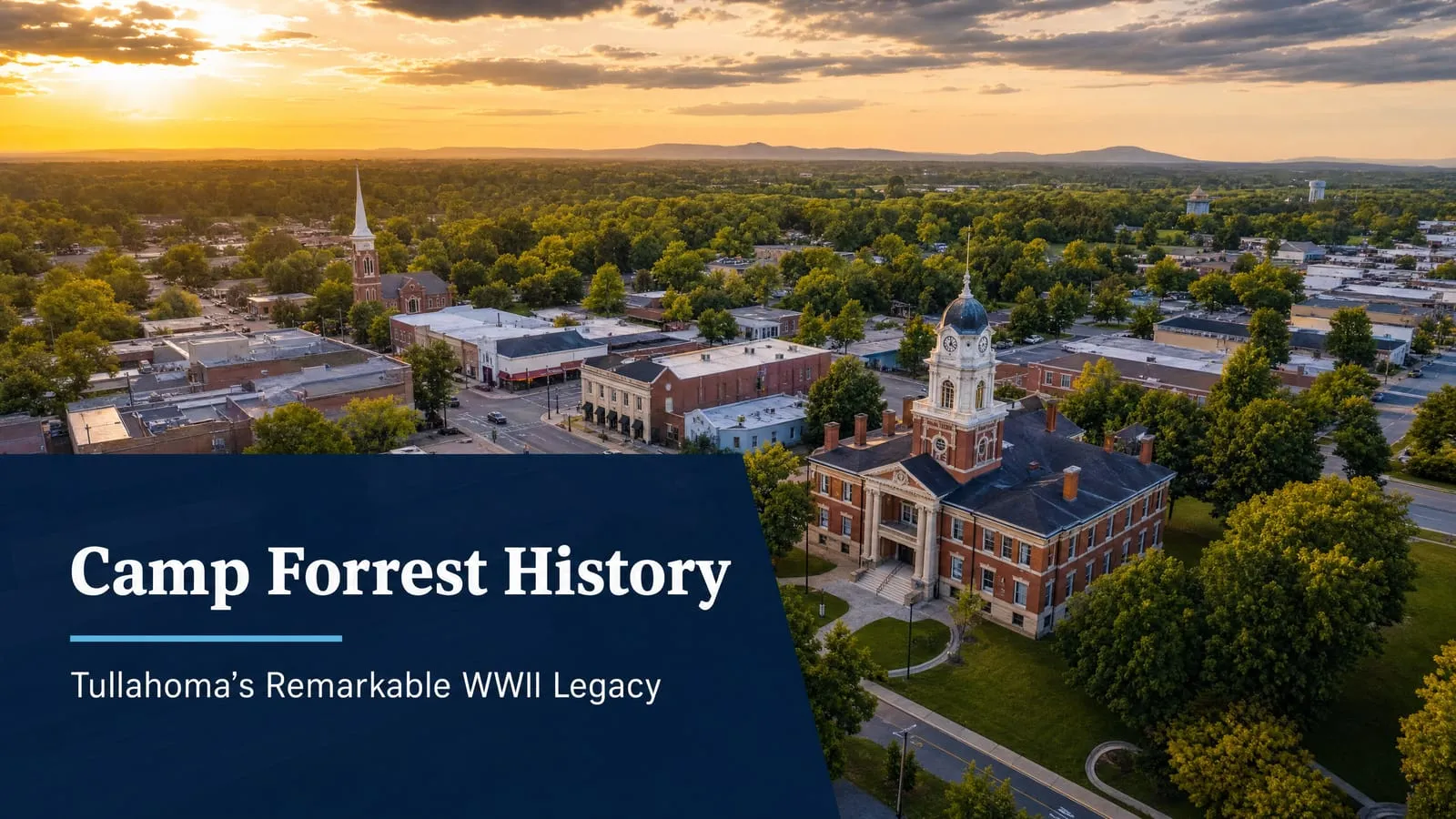

Camp Forrest History: Tullahoma's Remarkable World War II Legacy
Beneath the modern surface of Tullahoma, Tennessee lies one of the most remarkable military stories in American history. During World War II, this quiet Tennessee community was transformed into one of the largest military training installations in the United States — a sprawling 85,000-acre base called Camp Forrest that trained hundreds of thousands of soldiers, housed tens of thousands of prisoners of war, and temporarily swelled Tullahoma's population from 4,500 to 75,000. Understanding Camp Forrest's history helps explain why Tullahoma became the defense and aerospace community it is today — and why living here means living alongside a legacy of national service.
As a Tullahoma real estate agent and community advocate, I believe the stories that shaped this city deserve to be told. Here's the history of Camp Forrest and its lasting impact on the Tullahoma community.
Origins: From National Guard Camp to Army Base
The military history of the Tullahoma area predates World War II. In 1926, the Tennessee National Guard established Camp Peay on approximately 1,040 acres of wooded land east of Tullahoma. Named for Governor Austin Peay, the facility served as a training ground for Guard units during the interwar years.
Everything changed in 1941. As the United States prepared for war, the U.S. Army took over the Camp Peay site and expanded it dramatically — from 1,040 acres to an enormous 85,000 acres. The renamed installation was called Camp Forrest, and virtually overnight, Tullahoma was thrust into the center of America's wartime mobilization.
A City Within a City: Camp Forrest at Its Peak
At its peak, Camp Forrest was a self-sustaining military city where over 70,000 soldiers were stationed at any given time and approximately 12,000 civilians were employed throughout the war. The impact on Tullahoma was staggering — the community's population exploded from 4,500 before the war to approximately 75,000 during the camp's operational peak.
The scale of Camp Forrest is difficult to comprehend today. The 85,000-acre installation included barracks, mess halls, hospitals, recreation facilities, training grounds, firing ranges, and the infrastructure needed to house and train tens of thousands of soldiers simultaneously. For the residents of tiny Tullahoma, the transformation was as dramatic as anything the war produced on the home front.
Training America's Fighting Force
Camp Forrest served as a training facility for some of the war's most important military units. The installation trained eleven infantry divisions, two battalions of Rangers, numerous medical and supply units, and Army Air Corps personnel — preparing soldiers for combat across both the European and Pacific theaters.
The Rangers at Pointe du Hoc
One of Camp Forrest's most significant contributions to the war effort was training the Second Ranger Battalion. These soldiers, who honed their skills on the grounds east of Tullahoma, went on to win lasting fame during the D-Day invasion on June 6, 1944, when they scaled the ninety-foot cliffs of Pointe du Hoc under withering German fire — one of the most legendary feats of the entire war.
The fact that some of the most celebrated warriors in American military history trained on Tullahoma soil connects this community to one of the defining moments of the twentieth century.
Prisoner of War Operations
In 1942, Camp Forrest's mission expanded to include prisoner of war internment. The camp officially became a POW facility on May 12, 1942, and over the course of the war, it housed thousands of captured enemy combatants — primarily German and Italian soldiers, many captured during the North African campaigns.
At its peak, Camp Forrest held approximately 24,000 prisoners of war, members of the German Wehrmacht who found themselves in the Tennessee countryside after being captured on distant battlefields. Italian POWs were also interned at the camp, and for a brief period in 1942, approximately 190 Japanese American internees from Hawaii were held at Camp Forrest — part of the broader internment program that remains one of the most controversial chapters in American wartime history.
The Intellectual Diversion Program
In 1945, as the war in Europe wound toward its conclusion, the U.S. government implemented an Intellectual Diversion Program at Camp Forrest designed to educate German POWs about American democracy and the American way of life. Through educational materials, recreational media, and organized programming, the government sought to reshape the worldviews of prisoners before their eventual repatriation to a postwar Germany that would need democratic citizens.
Impact on the Tullahoma Community
Camp Forrest's presence transformed Tullahoma in ways that extended far beyond the war years. The massive influx of soldiers and civilian workers created an economic boom that built infrastructure, expanded businesses, and established Tullahoma as a community with deep military connections.
The civilian employment — approximately 12,000 jobs during the war — provided income and experience to local residents who had lived through the Depression. The military infrastructure built during the war years laid the groundwork for the community's postwar development, including the establishment of what would become Arnold Engineering Development Complex (AEDC).
From Camp Forrest to AEDC
When Camp Forrest closed in 1946 after the war's end, the massive military installation didn't simply disappear. The site's infrastructure, location, and established military connections made it an ideal candidate for postwar military research and development.
Today, the Arnold Engineering Development Complex of the United States Air Force occupies the former Camp Forrest site. AEDC evolved into the world's most advanced aerospace ground-testing facility, employing thousands of engineers, scientists, and support professionals who live in Tullahoma and the surrounding communities.
The direct line from Camp Forrest to AEDC means that Tullahoma's identity as a defense and aerospace community stretches back over 80 years. The wartime investment in this location set the stage for a permanent military-technology presence that continues to drive the local economy and attract skilled professionals from across the country.
Preserving the Legacy
Tullahoma honors the Camp Forrest legacy through several community institutions and preservation efforts.
The Tullahoma Fine Arts Center houses the permanent "Legacies of Camp Forrest" exhibition, displaying artifacts, photographs, and historical materials that document the camp's history and its impact on the community. For residents and visitors who want to understand this chapter of Tullahoma's story, the exhibition provides a tangible connection to the wartime past.
The Mitchell Museum at the South Jackson Performing Arts Center also contains exhibits pertaining to Tullahoma's local history, including the Camp Forrest era. Historical markers around the community identify sites connected to the camp's operations.
The Tennessee State Library and Archives maintains a photographic collection from Camp Forrest spanning 1941-1945, preserving visual documentation of the installation's operations for researchers and descendants of soldiers who trained there.
Why This History Matters for Today's Families
Understanding Camp Forrest helps families appreciate what makes Tullahoma different from other small Tennessee cities. The wartime experience created a community culture that values military service, technical expertise, and patriotic commitment. These values persist today in Tullahoma's support for AEDC employees, its VA clinic for veterans, the Marine Corps JROTC program at Tullahoma High School, and the community's deep respect for the men and women who serve.
For families relocating to Tullahoma — particularly military families, defense professionals, and veterans — this cultural foundation means moving to a community that understands and appreciates their service. Camp Forrest's legacy is written into Tullahoma's DNA, and it shows in how the community welcomes and supports those connected to national defense.
Discover Tullahoma's History and Future
Contact Jon Smith today at jonsmithrealtor.com to find your home in a community with deep roots and a bright future. Whether you're drawn to Tullahoma's history, its aerospace economy, or its family-friendly lifestyle, I'll help you find the property that connects you to everything this community offers.
Browse all Tullahoma homes for sale or read my guide to AEDC careers and jobs to learn about the modern aerospace economy that grew from Camp Forrest's legacy.