
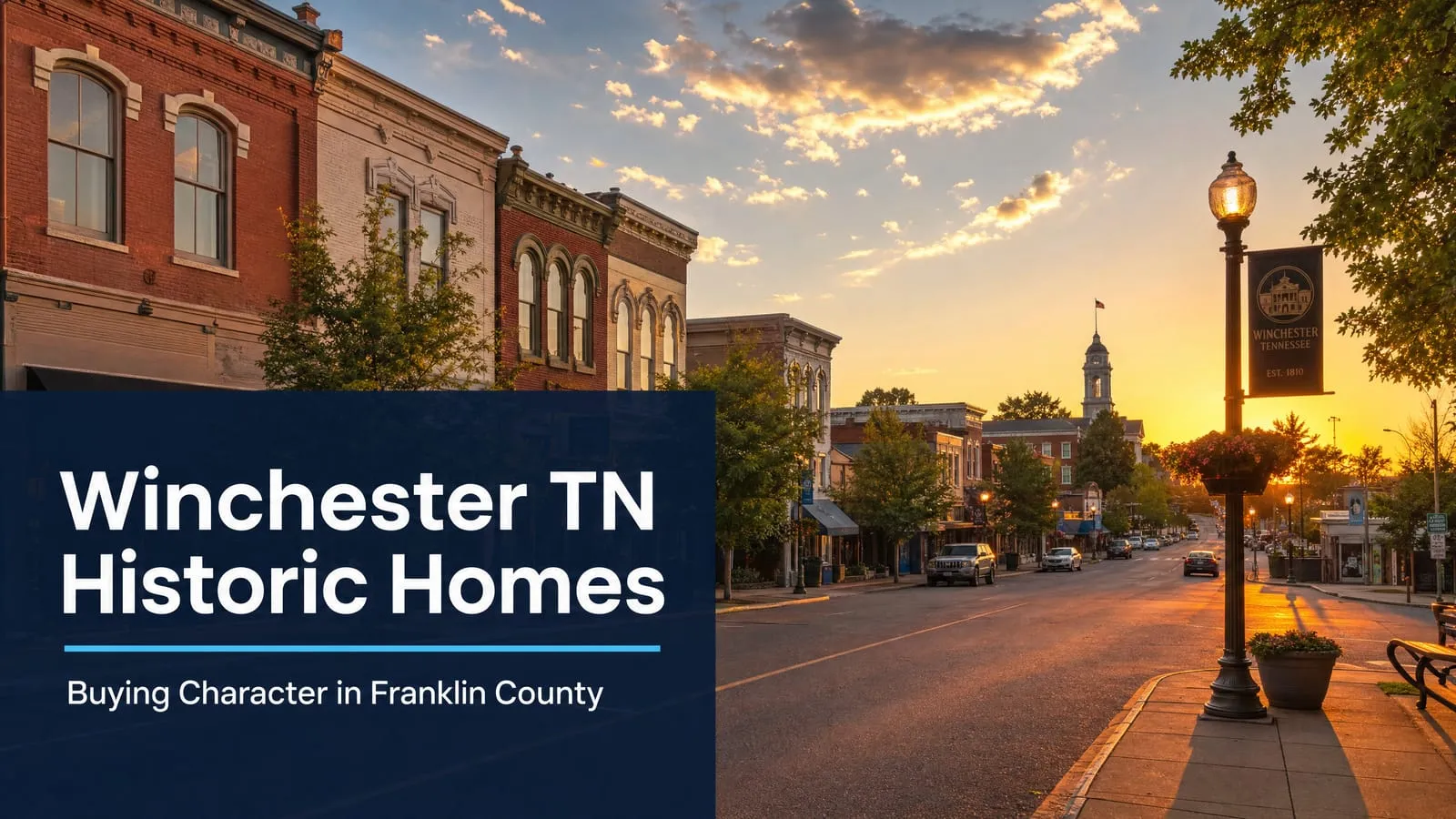

Winchester TN Historic Homes: Buying Character in Franklin County
Winchester has something that newer Tennessee towns simply cannot replicate: history built into the walls. As the county seat of Franklin County since 1808, Winchester's residential streets and downtown square contain homes spanning nearly two centuries of American architecture — from antebellum farmhouses and Victorian-era residences to early twentieth-century Craftsman bungalows and mid-century ranch homes. For buyers drawn to character, craftsmanship, and the kind of architectural detail that modern construction rarely delivers, Winchester offers historic homes at a fraction of what comparable properties cost in Nashville's historic neighborhoods. This guide covers what to know before buying a historic home in Winchester — from the architectural styles you will find to the insurance, renovation, and maintenance considerations that come with owning a piece of Franklin County's history.
Winchester's Architectural Heritage
Winchester's history as home to four Tennessee governors — Isham G. Harris, Henry Horton, Albert Smith Marks, and Peter Turney — and as a prosperous county seat through the 1800s and early 1900s left behind a residential building stock that tells the story of Middle Tennessee's development.
The Hundred Oaks legacy. Winchester's most famous historic property is Hundred Oaks Castle, whose construction began in the 1830s as a plantation farmhouse built by Benjamin Decherd — the railroad tycoon for whom the town of Decherd was named. Later purchased by Albert Smith Marks, Tennessee's 21st governor, the property was transformed in the 1890s into a castle featuring Jacobean, Romanesque, and Dutch architectural elements designed by Samuel M. Patton of Chattanooga. While Hundred Oaks itself is not a typical home purchase, it represents the ambition and architectural quality that characterized Winchester's most prominent residents — an ambition that filtered down to the homes built throughout the town's residential neighborhoods.
Downtown square architecture. Winchester's courthouse square features buildings dating to the early 1900s, including the Art Deco Franklin County Courthouse. Many buildings around the square display plaques documenting their individual histories, and the town has invested in revitalizing the downtown area — restoring historic facades, introducing new businesses, and improving public spaces. Living near the square means walkable access to this architectural heritage and the growing downtown scene.
Historic Home Styles You Will Find in Winchester
Winchester's residential neighborhoods contain several distinct architectural periods, each with its own character and considerations for buyers.
Antebellum and Civil War-era homes (1830s-1860s). The oldest residential structures in Winchester date to the town's early development. These homes feature high ceilings, wide-plank hardwood floors, deep porches, and construction methods (hand-hewn timbers, brick masonry) that reflect the craftsmanship of the era. Properties from this period are rare and command premium prices for their historical significance. Buyers should expect extensive renovation needs — updated electrical, plumbing, and HVAC systems are almost always required — and should budget accordingly.
Victorian-era homes (1870s-1910s). Winchester's post-Civil War prosperity produced Victorian residences with decorative trim, wraparound porches, high ceilings, and the ornamental detail that defines the style. These homes are found primarily in the neighborhoods surrounding the courthouse square and along the town's main residential corridors. Victorian homes offer dramatic curb appeal and generous room sizes but often need foundation work, roof replacement, and modernization of systems that may not have been updated in decades.
Craftsman bungalows (1910s-1940s). The Craftsman style — characterized by low-pitched roofs, wide eaves, covered front porches with tapered columns, and built-in cabinetry — represents the most practical balance of historic character and livability for many buyers. Winchester's Craftsman homes are typically 1,200 to 1,800 square feet, well-suited to modern family life, and often more affordable than larger Victorian properties. Many have been maintained or partially updated, reducing the renovation burden.
Mid-century homes (1940s-1960s). Not "historic" in the traditional sense, but Winchester's mid-century housing stock offers solid construction, simple layouts, and affordable price points ($150,000 to $225,000) that appeal to both homeowners and investors. These homes represent the majority of Winchester's affordable housing inventory and are the starting point for many first-time buyers using FHA or THDA financing.
Where to Find Historic Homes in Winchester
The courthouse square area. The blocks immediately surrounding the Franklin County Courthouse contain Winchester's highest concentration of historic homes. These properties range from modest Craftsman bungalows to substantial Victorian residences. Walking distance to the square, local restaurants, and community events makes this area appealing for buyers who value walkability and town-center living.
Residential corridors along main streets. The streets radiating from the square — particularly along the established residential corridors — feature larger homes on deeper lots with mature trees, established landscaping, and the kind of neighborhood character that develops over a century of continuous habitation. These are the streets where Winchester's professionals, business owners, and civic leaders built their homes from the 1870s through the 1940s.
Surrounding rural properties. Outside Winchester proper, Franklin County contains historic farmhouses, rural estates, and agricultural properties with historic structures. Some of these properties sit on significant acreage and include barns, outbuildings, and land that reflect the county's agricultural heritage. Properties near the Cowan area and along the routes toward Estill Springs occasionally offer historic homes on rural parcels at prices that would be unthinkable in Nashville's historic neighborhoods.
What to Know Before Buying a Historic Home
Historic homes reward informed buyers and punish impulsive ones. Here is what to evaluate before making an offer.
Structural integrity. The most critical evaluation point for any pre-1950 home is the foundation and structural system. Stone foundations, pier-and-beam systems, and original brick masonry may have settled, cracked, or deteriorated over decades. A qualified structural engineer — not just a general home inspector — should evaluate any historic home you are serious about purchasing. Foundation repairs on a historic home can run $5,000 to $30,000 or more, and discovering the need after closing is financially devastating.
Electrical systems. Many historic homes in Winchester were built before modern electrical standards existed. Knob-and-tube wiring, undersized electrical panels, and inadequate grounding are common in homes that have not been fully rewired. A complete electrical update in a 2,000-square-foot historic home costs $8,000 to $15,000 — a necessary expense for safety and insurability. Some insurance companies will not write policies on homes with knob-and-tube wiring.
Plumbing. Original galvanized steel plumbing corrodes from the inside over decades, restricting water flow and eventually failing. Cast iron drain lines crack and root-infiltrate. A full plumbing update costs $5,000 to $12,000 depending on the home's size and layout. Check water pressure, drainage speed, and visible pipe material during your home inspection.
HVAC. Original historic homes were not designed for central air conditioning, and many were heated with coal or oil systems long since converted to natural gas or electric. Retrofitting modern HVAC into a historic home requires creative ductwork routing (often through closets, chases, or crawlspaces) and costs $8,000 to $20,000. Mini-split systems offer a less invasive alternative for homes where traditional ductwork is impractical.
Roof condition. Historic homes often have complex rooflines — dormers, valleys, and multiple slopes — that require more maintenance and are more expensive to replace than simple gable roofs. A roof replacement on a 2,000-square-foot historic home with a complex roofline costs $12,000 to $25,000. Verify remaining roof life during inspection and budget for replacement if it is within five years.
Insurance Considerations for Historic Homes
Insuring a historic home in Winchester requires specialized coverage that standard homeowner's policies often do not provide.
Guaranteed replacement cost coverage. Standard replacement cost policies cap your payout at the policy limit. For historic homes, where period-accurate materials and skilled craftsmanship cost far more than modern equivalents, guaranteed replacement cost coverage ensures your insurer pays whatever it takes to restore the home — even if costs exceed the policy limit. This is the most important coverage type for a historic homeowner.
Ordinance or law coverage. Historic homes often do not meet current building codes. After a loss (fire, storm damage, etc.), local ordinances may require you to upgrade plumbing, electrical, and structural elements to current standards as a condition of rebuilding. Ordinance or law coverage pays for these mandatory updates — costs that standard policies exclude. Without this coverage, a partial loss can become financially catastrophic when code-required upgrades multiply the repair cost.
Higher premiums. Expect to pay 20% to 40% more for homeowner's insurance on a pre-1950 home compared to a comparable newer home. The higher cost reflects the increased replacement cost (period materials and craftsmanship), the higher risk profile (older electrical, plumbing, and roofing), and the complexity of claims on homes with unique architectural features. Budget $2,200 to $3,500 per year for comprehensive coverage on a $250,000 to $350,000 historic home in Winchester.
Specialist insurers. Several insurance companies specialize in historic and older homes — they understand the unique risks and provide appropriate coverage without the exclusions that general insurers may apply. Ask your agent about carriers that specifically serve the historic home market.
Renovation: Preserving Character While Adding Function
The best historic home renovations honor the original character while adding the systems and comfort that modern living requires.
Preserve original features. Hardwood floors, crown molding, mantels, built-in cabinetry, original hardware, and architectural trim are the features that give a historic home its value and character. Stripping these features during renovation destroys the very quality that makes the home special. Refinish rather than replace. Restore rather than remove. Buyers who appreciate historic homes will pay a premium for original features when you eventually sell.
Modernize systems invisibly. The goal of system updates (electrical, plumbing, HVAC) in a historic home is to make the home function like a modern house while looking like a historic one. This means concealed wiring, hidden ductwork, and plumbing routed through walls and chases rather than exposed across ceilings. Experienced contractors who specialize in older homes understand how to achieve this balance — general contractors without historic home experience often take shortcuts that damage the home's character.
Kitchen and bathroom updates. These are the rooms where modern expectations and historic character collide most dramatically. The most successful approach: modern appliances and fixtures within a design framework that respects the home's period — Shaker-style cabinetry in a Craftsman home, for example, rather than ultra-modern flat-panel cabinets that clash with the architecture. Budget $25,000 to $50,000 for a kitchen renovation and $10,000 to $20,000 per bathroom in a historic home.
Find the right contractors. Not every contractor is equipped to work on historic homes. Period-accurate restoration, plaster repair, historic window restoration, and creative system retrofitting require specific skills. Ask for references from other historic homeowners, check for experience with pre-1950 construction, and verify that the contractor understands the difference between renovation (upgrading to modern standards) and restoration (preserving or returning to original condition).
The Financial Case for Historic Homes in Winchester
Historic homes in Winchester offer a compelling value proposition compared to Nashville's historic neighborhoods.
Acquisition cost. A 2,000-square-foot Craftsman bungalow in Winchester's historic neighborhoods can be acquired for $175,000 to $275,000. A comparable home in Nashville's East Nashville, Germantown, or 12South would cost $500,000 to $800,000 or more. Even after budgeting $30,000 to $60,000 in renovation, the all-in cost in Winchester remains dramatically below Nashville prices.
Appreciation potential. Winchester's downtown revitalization is increasing the value of nearby historic homes. As the square attracts new businesses and community investment, surrounding residential property benefits. Historic homes in revitalizing downtowns have consistently outperformed average appreciation rates in comparable markets — the combination of limited supply (they are not building more 1920s Craftsmans), growing demand (driven by revitalization), and inherent character creates a favorable appreciation dynamic.
Property taxes. Franklin County's effective property tax rates are lower than Coffee County and significantly lower than Nashville's Davidson County. On a $250,000 historic home inside Winchester, expect approximately $2,125 to $2,375 per year in property taxes — a fraction of what a comparable Nashville home would cost in taxes alone.
FAQ
Are historic homes in Winchester expensive?
No — not by Nashville or even Chattanooga standards. Historic homes in Winchester range from $150,000 for smaller properties needing renovation to $350,000+ for larger, well-maintained residences. Craftsman bungalows in the $175,000 to $250,000 range offer the best balance of character, condition, and affordability.
Do I need special permits to renovate a historic home in Winchester?
If the property is in a locally designated historic district, exterior changes may require design review. Interior renovations generally do not require historic review. Verify with the city whether your property falls in a regulated district before planning exterior modifications. Even outside designated districts, preserving historic character is wise — it protects your investment.
Can I use FHA or VA loans on a historic home?
Yes, as long as the home meets FHA or VA minimum property requirements — safe electrical, functional plumbing, structurally sound, and habitable condition. Some historic homes in their current condition may not meet these requirements without repairs. An FHA 203(k) renovation loan allows you to finance the purchase and renovation in a single mortgage — an excellent option for historic homes that need updating.
Is it worth buying a historic fixer-upper in Winchester?
It can be — if you budget accurately and find the right contractors. The spread between a distressed historic home ($120,000 to $160,000) and a fully renovated one ($250,000 to $325,000) can create significant equity. But renovation costs on historic homes are notoriously difficult to predict — budget 20% to 30% above initial estimates as a contingency.
How do historic homes compare to new construction in Winchester?
New construction offers modern systems, energy efficiency, and warranty coverage. Historic homes offer architectural character, craftsmanship, mature landscaping, and established neighborhoods. The choice depends on your priorities — convenience and predictability versus character and uniqueness. Many buyers find that the quality of materials and craftsmanship in a well-maintained 1920s home exceeds what most modern builders deliver.
Find Your Historic Home in Winchester
I know Winchester's historic neighborhoods — which streets have the best-preserved homes, which properties have been updated and which need work, and which offer the best value for buyers who appreciate character. If owning a piece of Franklin County history appeals to you, let me help you find the right property.
Contact me about historic homes in Winchester →