
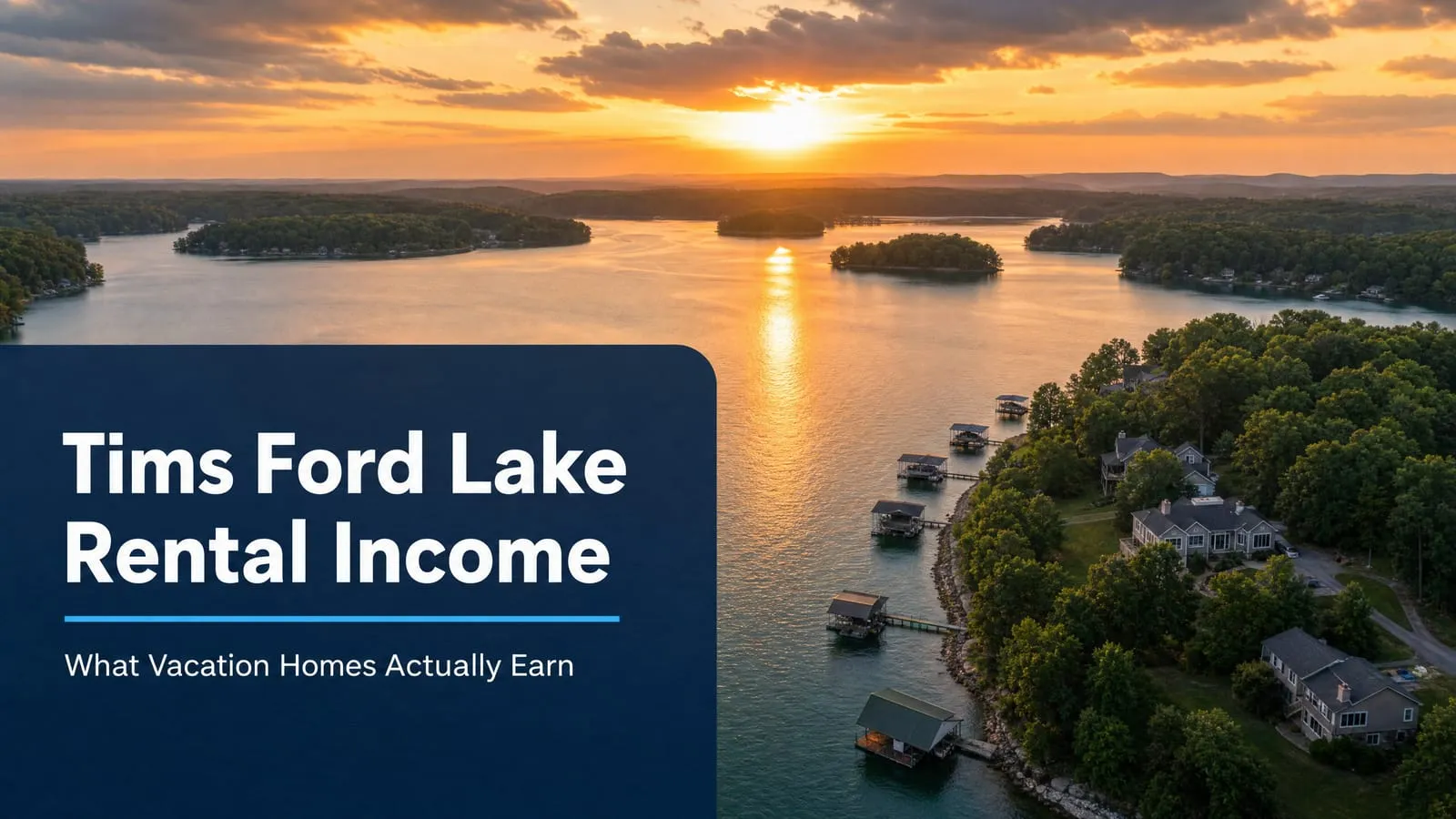

Tims Ford Lake Rental Income: What Vacation Homes Actually Earn
Tims Ford Lake is one of the premier recreational lakes in Middle Tennessee — 10,700 acres of clear water, over 250 miles of shoreline, and a location that puts it within 90 minutes of Nashville, making it a natural weekend destination for the metro area's 2 million+ residents. For real estate investors, the question is straightforward: can you buy a lake home or lake-access property and generate enough vacation rental income to justify the investment? This guide breaks down the real revenue numbers, occupancy patterns, operating costs, and ROI scenarios for short-term rental properties on and near Tims Ford Lake.
Why Tims Ford Lake Draws Vacation Renters
Understanding the demand side of the equation starts with understanding why people come to Tims Ford.
Proximity to Nashville. Tims Ford Lake is approximately 80 to 90 minutes southeast of Nashville via I-24 — close enough for a Friday-to-Sunday weekend trip without the exhaustion of a long drive. For Nashville families looking for a lake weekend without the four-hour drive to Norris Lake or Dale Hollow, Tims Ford is the closest quality option.
Bass fishing. Tims Ford is consistently ranked among Tennessee's top bass fishing lakes. Tournament fishing, recreational fishing, and guided fishing trips drive a steady stream of visitors, particularly in spring (March through May) and fall (September through November). Fishing guests often book midweek stays, which improves overall occupancy beyond weekend-only patterns.
Family recreation. Boating, swimming, kayaking, paddleboarding, and hiking at Tims Ford State Park attract family groups throughout the summer. The typical family booking is three to five nights during June and July, with groups often booking properties that accommodate 8 to 12 people.
Jack Daniel's Distillery proximity. Lynchburg and the Jack Daniel's Distillery are approximately 30 minutes from the Winchester side of the lake. Visitors combining a distillery tour with a lake weekend create a secondary demand driver that extends beyond pure outdoor recreation.
Tennessee's statewide Airbnb occupancy rates average 66% — notably above the national average of 58% — and daily rates average $198 versus the national average of $175. The state's short-term rental market is projected to grow 12% to 15% annually, driven by tourism expansion and Tennessee's reputation as a leisure destination.
Revenue Projections: What Properties Actually Earn
Based on comparable vacation rental performance data for lake properties in Middle Tennessee, here are realistic revenue projections by property type near Tims Ford Lake.
3-bedroom lake-access home (no dock, lake within walking distance or short drive):
Nightly rate: $150 to $225 depending on season, condition, and amenities. Peak season (May-September) occupancy: 65% to 80%. Off-season (October-April) occupancy: 25% to 40%. Annual gross revenue: $25,000 to $38,000. These properties are the most accessible entry point for vacation rental investors, with acquisition costs of $225,000 to $325,000.
3-4 bedroom lakefront home with dock:
Nightly rate: $225 to $400 depending on size, dock quality, and finishes. Peak season occupancy: 75% to 90%. Off-season occupancy: 30% to 45%. Annual gross revenue: $40,000 to $65,000. These are the highest-performing vacation rentals on the lake. Acquisition costs range from $350,000 to $600,000+ depending on frontage, views, and home quality.
Large group property (5+ bedrooms, sleeps 12+):
Nightly rate: $350 to $600+. Peak season occupancy: 70% to 85%. Off-season occupancy: 20% to 35%. Annual gross revenue: $55,000 to $90,000. Family reunion and group bookings drive premium rates but also require larger properties with higher maintenance costs. Acquisition: $450,000 to $800,000.
The seasonal reality: Tims Ford Lake vacation rentals earn 65% to 75% of their annual revenue between May and September. The remaining 25% to 35% comes from fall fishing weekends, holiday bookings, and occasional winter getaways. This seasonal concentration means you need strong peak-season performance to cover the carrying costs during the slow months.
Operating Costs: The Numbers Nobody Advertises
Gross revenue is not profit. Here are the operating costs that reduce your revenue to actual cash flow.
Property management (20-25% of gross revenue): Full-service vacation rental management includes guest communication, booking management, cleaning coordination, maintenance dispatch, and listing optimization. On a $40,000 gross revenue property, management costs $8,000 to $10,000/year. Self-management saves this cost but requires 10 to 20+ hours per week during peak season.
Cleaning and turnover ($100-$200 per turnover): Each guest departure requires professional cleaning. A property with 80 to 100 turnovers per year (typical for a well-booked vacation rental) spends $8,000 to $20,000 annually on cleaning. This is separate from the management fee. Some managers include cleaning in their fee; most charge it separately or pass it to guests as a cleaning fee.
Utilities ($300-$600/month): Vacation rentals consume more utilities than long-term rentals because guests run the HVAC at full blast, take long showers, and leave lights on. Budget $3,600 to $7,200/year for electric, water, internet (essential — guests expect fast WiFi), and propane/gas if applicable. Lake properties with hot tubs add $100 to $200/month in electric costs.
Insurance ($2,500-$4,500/year): Short-term rental insurance costs significantly more than standard homeowner's insurance. You need a commercial or landlord policy that specifically covers short-term rental activity, liability for guest injuries, and loss of rental income. Standard homeowner's policies do not cover vacation rental use and will deny claims if a guest is injured.
Property taxes: Franklin County property taxes on a $400,000 lakefront home run approximately $2,700 to $3,400/year. Properties in unincorporated Franklin County (where many lake homes are located) benefit from lower rates.
Maintenance and repairs ($3,000-$8,000/year): Lake properties take extra wear — docks need maintenance ($500 to $2,000/year), decks need staining, HVAC works harder, and guest-caused damage accumulates. Budget 3% to 5% of property value annually for maintenance and capital reserves.
Lodging tax: Tennessee requires collection and remittance of state sales tax (7%) and applicable local occupancy taxes on short-term rentals. Airbnb and VRBO collect and remit state taxes automatically in Tennessee, but some local taxes may require direct filing. Budget for this in your pricing — it affects your competitive nightly rate.
Furnishing and setup ($15,000-$35,000 initial): Vacation rentals must be fully furnished, equipped, and decorated. A 3-bedroom lake home needs beds, linens, cookware, dishes, towels, outdoor furniture, fire pit, games, and decor that photographs well. First-year furnishing costs of $15,000 to $35,000 are typical. Budget $2,000 to $4,000/year for replacements and upgrades.
Cash Flow Analysis: A $375,000 Lake-Access Property
Here is a realistic scenario for a 3-bedroom lake-access home purchased as a vacation rental.
Acquisition: Purchase price $375,000. Down payment 25% ($93,750). Loan $281,250 at 7.25%. Closing costs $8,000. Furnishing $22,000. Total cash invested: $123,750.
Annual revenue: Gross rental income $35,000 (conservative estimate for a well-managed lake-access property).
Annual expenses: Mortgage P&I ($23,025). Property taxes ($2,800). Insurance ($3,200). Property management at 22% ($7,700). Cleaning/turnover ($10,000). Utilities ($5,400). Maintenance ($5,000). Total expenses: $57,125.
Annual cash flow: -$22,125. Negative — the property does not cash flow at current rates with a mortgage.
But the total return picture: Principal paydown ~$5,500/year. Appreciation at 4% ~$15,000/year. Tax benefits (depreciation + deductions) ~$4,000 to $6,000/year. Total return: approximately $2,375 to $4,375 positive, even with negative cash flow. Five-year total return on $123,750 invested: approximately $55,000 to $75,000 (44% to 60%), or 8% to 10% annualized.
Cash buyers change the equation dramatically. Without a mortgage, the same property generates approximately $900 to $2,000/month in positive cash flow — a 4% to 6% cash-on-cash return on a $405,000 total investment (purchase + furnishing), plus appreciation and tax benefits.
What Makes a Top-Performing Lake Rental
Dock or private water access. Properties with dock access generate 25% to 40% higher nightly rates than similar properties without. A TVA-permitted dock on Tims Ford Lake is a premium amenity that directly affects bookings and revenue.
Outdoor living spaces. Decks with lake views, screened porches, fire pits, hot tubs, and outdoor dining areas drive bookings and justify premium rates. The guest experience on a lake property is centered on outdoor living — invest here first.
Professional photography and listing optimization. Vacation rental bookings are driven almost entirely by online presentation. Professional photos, compelling descriptions, and optimized listings on Airbnb and VRBO generate 2x to 3x more inquiries than amateur listings. This is not an area to cut costs.
Guest amenities. Fast WiFi, a stocked kitchen, quality linens, a game room, kayaks or paddleboards, and a fire pit are the amenities that generate five-star reviews and repeat bookings. Each five-star review improves your search ranking on platforms, creating a compound effect on bookings over time.
FAQ
Can I use the property myself and still make money?
Yes, but every night you use it is a night of lost revenue. During peak season, a $300/night property costs you $300 for every night of personal use. Many investors block two to four weeks of personal use and rent the remaining weeks. The IRS also has rules about personal use affecting your ability to deduct rental losses — consult a tax professional.
Do I need to verify STR regulations before buying?
Absolutely. Short-term rental regulations vary by municipality around Tims Ford Lake. Some areas have no restrictions, while others may require permits, limit rental frequency, or impose zoning restrictions. Verify before you buy — not after.
How long does it take to reach stabilized revenue?
New vacation rental listings typically take 6 to 12 months to build reviews, optimize pricing, and reach stabilized occupancy. Budget for below-average revenue in year one. By year two, a well-managed listing should be performing at or near market averages.
Is a lakefront property worth the premium over lake-access?
Lakefront properties command 25% to 40% higher nightly rates and book faster. The premium acquisition cost ($100,000 to $200,000 more) is partially offset by higher revenue. Run the numbers for both scenarios — lakefront often produces better percentage returns despite the higher price.
What is the biggest mistake vacation rental investors make on Tims Ford?
Underestimating operating costs. Many investors project gross revenue and assume 50% or more drops to the bottom line. In reality, operating costs (management, cleaning, utilities, insurance, maintenance, taxes) consume 60% to 75% of gross revenue on a financed property. Run conservative projections before buying.
Invest in the Lake — With Real Numbers
I help investors evaluate Tims Ford Lake properties with full financial projections — not guesswork. I know which coves book well, which properties have dock potential, and which areas are most in demand. Let me run the numbers on specific properties so you make a data-driven decision.
Contact me for a Tims Ford Lake investment analysis →