
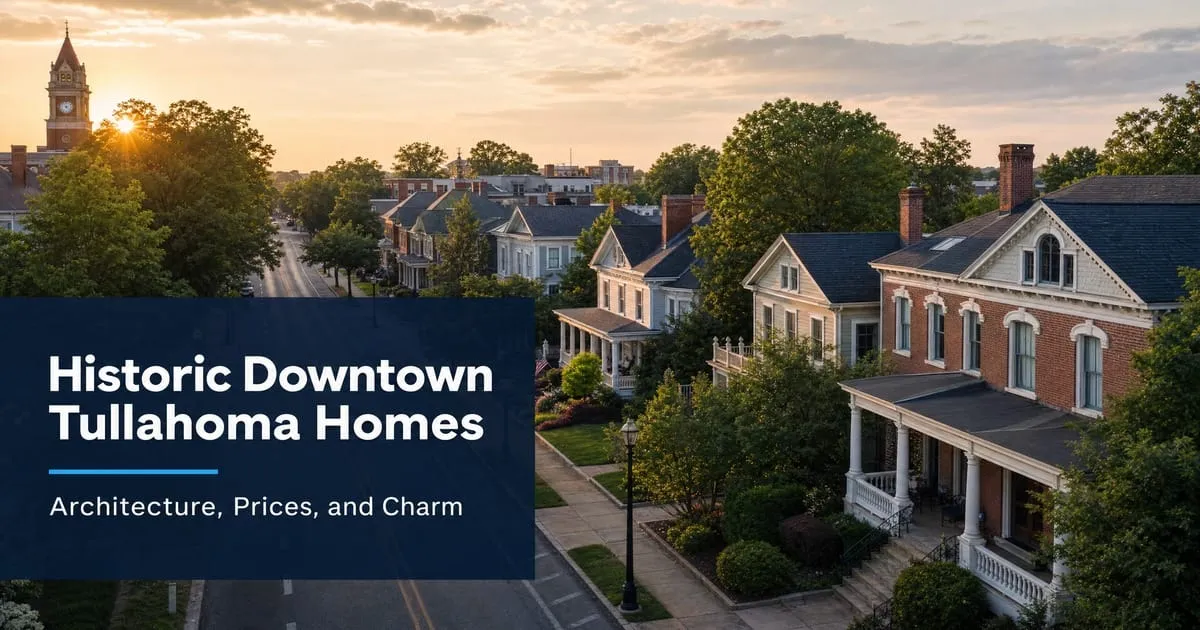

Historic Downtown Tullahoma TN: A Home Buyer's Guide to Character and Charm
For buyers who appreciate architectural character, walkability, and a connection to a city's heritage, historic downtown Tullahoma offers some of the most distinctive homes in Middle Tennessee. From Victorian-era residences along North Atlantic Street to early twentieth-century bungalows and Colonial Revival homes built by the city's original business leaders, downtown Tullahoma's housing stock tells the story of a community that has been thriving since its founding as a railroad town in 1852.
As a Tullahoma real estate agent, I help buyers navigate the unique opportunities and considerations that come with purchasing historic and vintage homes. Here's your complete guide to living in the heart of Tullahoma.
A Brief History of Downtown Tullahoma
Understanding the homes in downtown Tullahoma starts with understanding the city's history. Tullahoma was chartered in 1852 as a railroad camp along the new Nashville and Chattanooga Railroad. The city's founders laid out the town along the railroad line, with the street running alongside the tracks named Atlantic Street — a reference to the railroad's connection to the Atlantic seaboard that made Tullahoma a vital commercial hub for Middle Tennessee's agricultural products.
During the Civil War, Tullahoma gained strategic importance as the site of the longest undisturbed Confederate encampment of any army during the entire war, lasting from January through June 1863. Union General William S. Rosecrans eventually forced the Confederate withdrawal through his Tullahoma Campaign, and the city's Maplewood Cemetery still holds the graves of over 400 Confederate soldiers.
After the war, Tullahoma rebuilt and prospered thanks to its railroad connections. The city became known for its educational institutions and, at the turn of the twentieth century, emerged as a popular health destination, with spas throughout town capitalizing on the natural springs in the area. Manufacturing followed, including the General Shoe Corporation (later Genesco), established in 1924. Each era of growth left its mark on the city's residential architecture, creating the layered, eclectic housing stock that characterizes downtown Tullahoma today.
The North Atlantic Street Historic District
The crown jewel of Tullahoma's historic residential architecture is the North Atlantic Street Historic District, which contains one of the finest collections of late nineteenth and early twentieth century homes in Coffee County. The district represents architectural styles spanning from 1883 to 1938, built by the town's most prominent civic and business leaders during Tullahoma's most dynamic period of growth.
Notable homes within the district include the Raht Houses at 308 and 312 North Atlantic Street, built in 1891 for two sisters who married brothers who were prominent commercial tobacco buyers. These Queen Anne-style homes with Eastlake details are the oldest houses in the district and exemplify the ornate Victorian aesthetic of the era.
The Hicks House at 300 North Atlantic Street is a Colonial or Classical Revival-style residence built around 1907 for a man who served as mayor of Tullahoma from 1900 to 1920. The Thoma House at 500 North Atlantic Street is a Classical Revival and Colonial Revival home dating to approximately 1915, listed on the National Register of Historic Places.
The Smotherman House represents Georgian Revival architecture, designed by Nashville architect George Waller and built between 1932 and 1934. Its two-story red brick construction with classical entries and flanking one-story extensions is characteristic of the style and reflects the confidence of Tullahoma's business community even during the Depression era.
Architectural Styles You'll Find Downtown
Downtown Tullahoma's housing stock is diverse, reflecting over a century of construction in multiple architectural traditions. Buyers exploring the area will encounter several distinct styles.
Queen Anne Victorian (1880s-1900s): Characterized by asymmetrical facades, decorative woodwork, wraparound porches, turrets, and ornamental details. The Raht Houses are prime examples. These homes feature high ceilings, original hardwood floors, and craftsmanship that modern construction rarely matches.
Colonial Revival (1900s-1930s): Symmetrical, formal designs with centered entrances, columned porches, and balanced window placement. Several prominent homes on North Atlantic Street exemplify this dignified style, which was favored by Tullahoma's professional and business class.
Craftsman Bungalow (1910s-1930s): Low-pitched rooflines, wide eaves with exposed rafter tails, tapered columns on stone or brick piers, and built-in cabinetry. Craftsman homes are found throughout downtown Tullahoma's residential streets and remain extremely popular with buyers who appreciate their functional, human-scaled design.
Georgian Revival (1920s-1940s): Formal red brick construction with symmetrical facades, classical entry details, and restrained ornamentation. The Smotherman House is Tullahoma's premier example of this style.
Mid-Century Modern and Ranch (1950s-1970s): As Tullahoma expanded with the establishment of AEDC and Arnold Air Force Base in the early 1950s, post-war housing styles arrived. Ranch homes with low profiles, attached garages, and open floor plans fill neighborhoods radiating outward from the historic core.
Home Prices in Downtown Tullahoma
One of the most compelling aspects of buying a historic home in downtown Tullahoma is the affordability compared to historic districts in larger Tennessee cities. In Nashville's historic neighborhoods, comparable homes routinely command $600,000 to over $1 million. In Chattanooga's established districts, prices often exceed $400,000 to $500,000. Downtown Tullahoma offers genuine architectural heritage at a fraction of these costs.
Entry-level historic homes in the downtown area can be found in the $150,000 to $225,000 range. These are typically smaller homes — two to three bedrooms, 1,000 to 1,400 square feet — that may need cosmetic updating or more significant renovation. For buyers willing to invest in restoration, these properties offer the opportunity to own a piece of Tullahoma history while building significant equity.
Move-in ready historic homes in good condition generally range from $225,000 to $375,000, offering three to four bedrooms, 1,500 to 2,500 square feet, and a balance of preserved historic features and modern updates. Kitchens, bathrooms, and mechanical systems in this price range have typically been updated while maintaining the home's original character.
Premium historic properties — larger homes on prominent lots, homes with National Register designation, or fully restored properties with high-end finishes — can range from $375,000 to $500,000 or more. These represent the finest historic residences in the Tullahoma market and compare favorably in quality to homes costing twice as much in Nashville or Franklin.
The Walkability Factor
Downtown Tullahoma offers a walkable lifestyle that newer suburban developments can't replicate. Residents in the historic core can walk to restaurants, coffee shops, boutiques, and services along Jackson Street and Atlantic Street — Tullahoma's main commercial corridors. The ability to walk to dinner, grab a coffee, or run basic errands without getting in a car is a quality-of-life advantage that buyers increasingly prioritize.
The walkability extends beyond commerce. Caboose Park in the heart of downtown features the historic bright red train car that honors Tullahoma's railroad founding, along with a veterans memorial and historical markers. The Rock Creek Greenway trail system is accessible from the downtown area, providing connected walking and biking paths for exercise and recreation.
For families, walkability means children can navigate their neighborhood safely, and for retirees, it means maintaining independence and staying active without relying on a vehicle for every errand.
Renovating and Restoring Downtown Tullahoma Homes
Buying a historic home often means embracing the opportunity — and responsibility — of preservation and renovation. Downtown Tullahoma properties offer excellent restoration potential, and the city's lower construction costs make renovation projects more financially viable than in larger markets.
Common renovation projects in downtown Tullahoma homes include kitchen and bathroom modernization while preserving original layouts and room proportions; refinishing original hardwood floors that have been hidden under carpet; restoring or replicating original woodwork, trim, and built-in cabinetry; updating electrical systems to modern code requirements; replacing aging HVAC systems with efficient modern units; and restoring or replacing windows while maintaining the home's architectural character.
Cost advantages: Renovation costs in Tullahoma are meaningfully lower than in Nashville, Chattanooga, or Knoxville. Local contractors familiar with older construction techniques are available, and materials are generally less expensive than in larger markets. A comprehensive kitchen renovation that might cost $60,000 in Nashville can often be completed for $35,000 to $45,000 in Tullahoma.
Historic preservation considerations: Homes within the North Atlantic Street Historic District or listed on the National Register of Historic Places may have guidelines regarding exterior modifications. These guidelines help preserve the neighborhood's architectural integrity and can actually benefit homeowners by protecting property values. Interior modifications are generally unrestricted, allowing owners to modernize living spaces while maintaining the historic exterior that gives these homes their value and character.
Why Buy Historic in Tullahoma
Beyond the aesthetic appeal, historic downtown Tullahoma homes offer practical advantages that make them smart real estate investments.
Construction quality: Homes built in the late 1800s and early 1900s often feature old-growth lumber framing, solid brick construction, and craftsmanship details that are prohibitively expensive to replicate today. Original hardwood floors, plaster walls, and hand-built cabinetry have an authenticity and durability that modern materials can't match.
Established lots: Downtown properties typically sit on mature, landscaped lots with large trees that provide shade, privacy, and curb appeal. A 100-year-old oak tree can't be replicated by a new-construction landscaping budget.
Scarcity value: There is a fixed supply of genuine historic homes. Unlike new construction, which can be added to the market indefinitely, historic properties become rarer over time as some are lost to neglect, fire, or demolition. This scarcity supports long-term value appreciation.
Community character: Historic neighborhoods attract residents who care about their community's appearance and heritage. This shared investment in neighborhood quality creates a positive feedback loop that benefits all property owners in the area.
Find Your Historic Tullahoma Home
Whether you're drawn to the ornate details of a Queen Anne Victorian, the dignified proportions of a Colonial Revival, or the warm functionality of a Craftsman bungalow, downtown Tullahoma has a historic home waiting for you — at prices that make preservation accessible rather than aspirational.
Contact Jon Smith today at jonsmithrealtor.com to explore historic properties in downtown Tullahoma. I'll help you evaluate the condition, renovation potential, and long-term value of each property so you can buy with confidence.
Browse all Tullahoma homes for sale or learn more about other Tullahoma neighborhoods to compare your options across the city.